Category: culture

TV Teacher

Cooking shows do no in fact teach you how to cook.  So you are correct when you say you watch them but you still do not feel adept in the kitchen.  This is why they have morphed into reality show programs based on celebrity gossip, wild hair, eccentric personalities, and showpiece spectacles.  The shows cannot sustain as a cooking demonstrations because it is not working.

Learning is not fun, it is not passive, it cannot be done in your pj’s while eating cereal.  Learning takes time, concentration, note taking and information review, the active process of thinking.  TV does not make you think, that is the beauty behind it.

Cooking show are not working because things are not done real time.  The ingredients magically show up, ready to be tossed in the pot, the final product mysteriously has a twin that has already been cooked or assembled.  Gathering ingredients, sourcing, choosing the right one, measuring, chopping, peeling, all around handling, are the hardest parts in cooking.  Knowing when something is done or when to check it and  determining what heat to apply are the intuitive factors that come with calculation and experience.

The host is not actually handling the raw products which in turn makes them unidentifiable. This creates a distance between you and the knowledge of your food.   It makes you not know what to look for at the grocery store, it makes you not know how to eyeball amounts of things, you can’t register the texture or moisture content.

And of course, you cannot smell through the television, so I am not sure who thought this was a good idea.  Feeling, smelling, and intuition are large parts of knowing how to cook, instead of merely following a few recipes from Rachael Ray.

Basic Inspirations, Take 2

Part II, Chocolate

Like vanilla, chocolate is also a labor intensive and highly refined product.  While vanilla is the most fickle during the initial growing process, the science behind chocolate shines in the post growing production.  Also similar to vanilla, chocolate will only grow 20 degrees north and south of the equator.

Long before chocolate became a common ingredient, the Aztecs believed the chocolate was food from the gods, given to the humans by a rouge deity who later got punished for introducing this amazing ingredient to the humans.  How this myth got started is very believable, considering how non appealing the fruit growing on the tree it.  It looks like a giant papaya, the natural fruit looks nothing like the final product.  It is hard to believe that humans figured out this process without divine intervention.

Chocolate was used as a form of currency in ancient times and as soon as the revolutionary war.

Chocolate is the final product made with cacao as a base. In raw form, cacao is very bitter and needs to be fermented to develop taste.  After the fermentation process, the beans are dried and roasted to further develop flavor.  The shell is then removed, separating out the cocoa nibs.  The Mayans used part of the outer shell as a fermented sugar to make liquor, a  tradition that has stopped with the demise of the civilization.  I bet this liquor was delicious.  Chocolate was served as a frothy bitter beverage, flavored with vanilla, used as medicine and valued for its aphrodisiac properties.

Although this process has largely not changed since ancient times, this is where the development of chocolate stopped until it was introduced to the Spanish, who took it one step further.  The Spanish added sugar, segueing chocolate into the confection that we know today.  In 1815 a Dutch chemist figured out a way to make chocolate less bitter by adding alkaline salt.  In 1850 a Quaker figured out how to add melted cocoa butter back into pressed chocolate, giving chocolate the solid form that we know today.  In 1875 a Swedish man added milk and mild powder to chocolate, forming the Nestle company and really changing the face of chocolate.

After the cacao is shelled, the cocoa nibs are further broken down to create cocoa mass and cocoa butter.  These are then recombined to create the ideal blend of mass and butter for mouth feel and structure.  After the chocolate is blended, it goes through a process called conching.  A container is filled with metal beads that act a grinders, making the chocolate and sugar granules so small that the tongue cannot detect any particles or grittiness.  This process can take up to 72 hours.

After this step, the chocolate must be tempered so that the fat crystals align in such a way to create a uniform structure.  This is done through a particular formula of time, temperature, and movement.  This process is one of the steps that makes working with chocolate so difficult.  Once chocolate is melted down, the crystal struck has collapsed.  It must be built back up again with this closely monitored system.  If not done properly, the chocolate with crumble instead of snap, very important for mouth feel and structural integrity of the final product

The different percentages of chocolate and the corresponding bitterness is a result of adding back in cocoa butter, sugar, milk.  These are then recombined to create different percentage of chocolate, the most popular being unsweetened, semisweet, dark chocolate 65%, milk chocolate, and white chocolate.

Although native to Mexico, West Africa grows 2/3 of chocolate, half of this coming from the ivory coast.  Given how laborious and long the process of making chocolate is, there is no surprise that slavery plantations sprung up to deal with growing demand of this amazing product.  Although slavery is now demeaned inhumane, we currently still have a problem with child slavery.  There are some chocolate products labeled fair trade, but surprisingly, child slavery still exists.  The demand for cheap and available product has created a situation that is beyond immoral and very upsetting.

Outside of a tasty confection, chocolate has long been used as a form of medicine.  It is high in antioxidants, reduces heart burn, and is an anti inflammatory.  Not only is chocolate delicious, its history complex, the uses for chocolate are seemly endless.
Basic Inspirations, Take 1


Part I Vanilla

The vanilla bean is the seed of the orchid, how elegant and sexy is that?  It is used primarily in baking, perfume, and aromatherapy.  It has a strong, rich floral aroma that is both sweet and mildly earthy, it is well balanced and mellow: it is not too soft or too strong, it is not cloyingly floral, it is not too heavy or woody.  The term French vanilla refers to how the bean is used, rather than a particular species of bean.  French vanilla means a strong floral aroma combined with yolks, hence French Vanilla ice cream.

This seed pod is very precious, precarious, and delicate.  Outside of its natural habit, the vanilla flower has to be cultivated by hand because only one species of bee pollinates the flower.  Additionally, the flowers will only live for one day before they die.  Thus, this window for pollination is excruciatingly small, a one shot chance.  This means that the vanilla vine has to be monitored daily to detect when there flower develops and is ready for reproduction.  The vine does not flower all at once, individual flowers will form at their own speed.

Once the plant has been properly pollinated, it takes 6 months for the vanilla bean to reach maturity,  again requiring daily attention as each seed matures at different rate.  Once maturity has been reached, the pods must be picked by hand because they are so gentle.  This whole process is tender, attentive, and laborious.

This is the first step on the train ride before the seeds are ready for the market.  After an extensive 4 step curing and fermentation process that takes about 7 months, the now fragrant vanilla bean is packaged and ready to be graded and priced based on size and moisture.  Average bulk price per pound of grade A beans, about 120 beans, is $130. Beans sold to the consumer is about $8 per bean. The only spice more expensive is Saffron.

The four cultivators are Bourbon-Madagascar (representing 75% of the market), Mexican, Tahitian, and West Indian.  The picky vanilla plant will only grow between 10 and 20 degrees north and south of the equator.

The arduous bean must be stored in vacuum sealed packaging, or in an air tight glass vital for up to 8 months.  After over a year of development, this demanding bean will be optimal for use for just a little over half of that time, given that it is stored properly.  If not vacuumed sealed, the bean will last 2 months.

The vanilla bean is quite extraordinary. Once you split open this long, thin, dark brown pod you are bombarded with a zillion almost microscopic seeds.  It is seemingly impossible how intricate the inside of this sleek slip is.  This audacious bean has penetrated the market so all encompassing because of how amazing and universal the flavor is.  The story and development of this bean is truly amazing.  I am still trying to figure out how vanilla came to describe something boring and plain, when the flavor is so exquisite and it’s history so exotic.

Basic Inspirations in Detail

Vanilla and chocolate, both ubiquitous in desserts the world over, are native to Mexico.   These two ingredients are fascinating that they considered common given how labor intensive and rare they are.  They were originally cultivated by the Mayans, brought to outside world after the Columbus incident, developed into tasty treats by the French, made widely available by the industrial revolution.  The infamous Hernan Cortés is credited with bring both of these ingredients to the outside world.  The legacy of these flavors lives on, surpassing the fame of this conquistador, being a lasting link to a long dead civilization.

The history of these ingredients are long and bloody. It begins with the Aztecs equating the shelling of the cacao seeds with the scarifying of the human heart, and escalating into civilizations of slavery, plantations of forced labor, generations of exploration, and now with child labor violations.  Delicious.

We take these flavors for granted when in reality they have been consumed for thousands of years, have traveled the globe, and have extreme and laborious growing and production processes. Over the next two posts, Marigold is going to dive into detail about these amazing ingredients.

A White Thanksgiving?


I love the falling snow.  The flirtatious fluttering of giant, soft snowflakes topple downward, cartwheeling in the glee of being free from the heaviness of aquatic drops.  It is so pretty and peaceful.   The snowflakes lazily glide down without a care in the world, unaware of how its light weight can cause such a heavy burden.  You cannot capture the elusive snowflake, it vanishes upon touch.  It’s almost magical in its existence, this complex crystal of frozen water.  A frozen prism that sparkles rainbow confetti.  Each one is so intricate and so fragile, so blissfully inspiring in how such a small, delicate, almost invisible object cause can such dismay, foul language, full hearted grunts, such a scurry in the step, can change the mood of an entire city.  In a snowflake’s moment, the whimsical crystal can dispatch an entire fleet of large trucks with shovels so giant that you question the laws of gravity.   It certainly is motivating, these tiny lightweight miracles, that collectively can impact the world so ostentatiously.

Religion According to Marigold

God exists to deal with emotion.  This is why animals do not have religion. That is why we eat meat and have house pets.  Animals have feelings not emotions.  Why then is it so socially frowned upon to be emotional?  It is deemed to be weak, a feminine trait (God is definitely a man, always portrayed as a male, full of strength, fury, and testosterone). Emotion is seen as a vulnerability, yet we have created an entire social system, one that essentially rules the world, has given people the confidence to conquer the world, in order to deal with sadness, anger, and loss.  God is there to answer the omnipresent question of why are we here and why do why have to deal with pain?  God is to guide through hard times and to celebrate in good times, to keep our emotions balanced, to help us understand the instinctual world, to define feeling, to explain intuition, to deal with the effect of the cause.

There is science to explain emotion, God to understand it.  Those people who are considered emotional should be seen as people strong enough to digest this great mystery, to give voice to what is hidden behind our eyes, to unravel the mystery of butterflies in the stomach, to take the concrete weights off a broken heart.  Emotion is the driving forces behind all our motives; emotion is strength; emotion is a virtue.

Food Writing Upgrade

Not to focus the full fury of Marigold’s spite directly at one particular website, but the thesis of this particular argument is one that supports a more diverse amount of websites to deal with said issue.  There really is only one in which to point the digital finger, and that lucky contestant is Yelp.

Restaurants hate Yelp because it is the opinion of the ignorant masses.  The public also is over Yelp because it does not offer well balanced advice.   Yet consumers continue to use the website because they don’t know where else to go for a quick and informed decision on where to eat dinner, lunch, a quick snack, who offers breakfast.  There are so many restaurants in the big city, and so many contingents to evaluate.  Hungry people pour over stranger’s opinions and place their fate in what to order based on this amateur information.

The fact that Yelp is so popular and so mediocre goes to show that we need to have more food writers, more restaurant critics, and more websites that can digest this giant culinary scene for the hungry and rushed masses.  There needs to be more information offered up in the reviews, such as where is good for a group, where is good for a casual encounter, where is good for a quiet date, where is good for music, where is good to dine alone.  What places focus on healthy food, what places have small portions or large plates.  Where should you take your mom?  All of these fields of inquiry are important, but instead of having an informative amount of information provided, we get endless pictures of food and chef gossip.

We need more food professionals, more writers for digestion.

Pop Music According to Culinary Standards

Scientists say that what makes Indian foods so delicious is that there are not a lot of overlapping taste profiles.  The combination of dishes represents a large blanket of flavors, each dish adding something into the large pot of taste.  This is somewhat contradictory to what you would expect out of a scientific study to explain what makes food so delicious.  Obviously flavors that pair well together make something delicious, therefore one would assume that the most delicious food have a lot of similarities.  But the opposite is the case, it take a team of players to create a delicious playing field.  It takes a lot of separate moving parts to create an elaborate plan.  This synergy of sensation is what makes for the best meal.

This same concept of complexity in food can help explain what makes contemporary music so terrible.  There are not enough different sounds happening to create an intriguing and complex piece. Classical music is amazing because it has a million components moving harmoniously at the same time, a synergy of sounds creates a rich experience.  Pop music has maybe four things going on.  And while this can lead to something deliciously melodic, it cannot hold up on the grandiose scale of the auscultatory world.

Gifts from the Garden

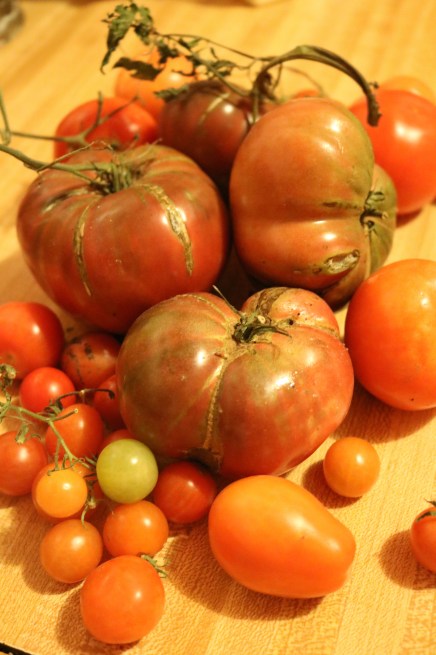
IMG_0817

Late ripening heirloom tomatoes are the trend in the 7th inning stretch in the Chicago summer.  The secrets of their jeweled inside hang seductively like hidden chandeliers.

We are uncertain if the good times are over, or if the weather might swing back into a good mood before the long hibernation ahead.

Holiday Hijack

Where did thanksgiving go? I thought that we collectively agreed as a culture to not start Christmas until after the esteemed Turkey Day?  Thanksgiving is an important holiday- it is the celebration of the final harvest before the cold sets in, honoring the life giving land, the mineral rich black soil that is the mother to us all, respecting the beauty of vegetables, the satisfaction of fruit, the life of birds.

This subtle societal agreement to wait for the Christmas is so far being observed that we are putting up Christmas posters and store art the very day after Halloween.  The very next day, just to rub it in like an immature revenge, the red and green are all abound, the lights twinkling from the ceiling, dead trees elaborately dressed in all the glory the living has to offer.  The tree blinks, and glistens, and glitters, topped with a star plucked from the heaves above.  Why are people so excited for Christmas?  We prepared so full heartedly, so spiritually enthusiastically, so momentously monetarily, so overwhelmingly aesthetically, and the very next day after Christmas it is all taken down and cast aside like a teenage crush.  After this big lead up to Christmas, we are so ready for it to be over.  How about instead we wait longer to get into the spirit and try to keep that joy around for a little longer than a day.  I don’t know if this nation of Christians are aware, but Christmas lasts for 12 whole days.  That’s like 12 times longer than we actually celebrate it.

Let’s bring back the wind up to thanksgiving, let reinvent the glamour in this holiday of culinary and harvest appreciation, and let’s try to give Christmas a fair shake.

Love,

Marigold.